
What to recommend and why: An algorithm that decides which hotel or LinkedIn post to trust; a good ad that makes you want to forward it to someone. This issue also looks at holiday data and how Airbnb scaled AI coding to 64% of pull requests.
“AI already has a view of your hotel. The question is whether it's correct.” That's the framework for Propellic's new hotel SEO guide. A traveler used to type in “Boutique Hotels in Charleston” and scroll through the links. Now she asked ChatGPT for a hotel with local roots that was under $400 a night and had a good restaurant, and got three names with reasons. Before she even visits your website, she's already been recommended.
The guide believes that AI models effectively form a view of each hotel. Your website is the starting point, but they then cross-check your claims against Reddit posts, TripAdvisor reviews, news reports, and directories. Consistent mentions from independent sources are considered verified. The weak or contradictory ones do not.
There are some other interesting things in the guide:
-
Reddit has become one of the most cited sources of AI travel answers. Early positive mentions of a property in related threads can influence how a model describes it over the years.
-
Keyword-driven H1 tags are one of the highest-payoff, lowest-effort SEO fixes. Most hotel websites still start with “Welcome to Meridian Hotels,” which is not the language people are searching for.
-
Rebranding does not automatically update what the AI model knows. If TripAdvisor and local directories still use the old name, then ChatGPT will also use the old name, sometimes even for years after the switch.
-
Bounce rates for traffic referred from ChatGPT are significantly lower than typical organic traffic because visitors are already pre-sold to the site when they arrive.
Independent hotels have advantages in this regard that chain hotels do not. No need to use corporate templates, full control of the narrative, and the ability to move quickly based on owned signals (site structure, patterns) and earned signals (media, Reddit, comments) weighted by the AI model.
Propellic is hosting a live webinar on how AI is reshaping hotel discovery and what to do about it. Register for free here. Thursday, July 16, 2026 at 10:00 AM Central Time. Hosted by Brennen Bliss (CEO and Founder of Propellic) and Javier Hernandez (Senior SEO Manager at Propellic). Live briefing and Q&A.
The same shift isn’t just happening on hotel websites. It also changes the way founders and software vendors are discovered. Pedro Dias Posted on LinkedIn He is “the world’s most renowned expert on AI visibility.” A few hours later, he posted again, this time showing an overview of Google's AI, repeating that exact statement and citing his own post as the source. He effectively turns LinkedIn posts into citation sources.
This is a mechanism that works exactly as designed. Meltwater analyzed 9.5 million AI citations in ChatGPT, Copilot, Gemini, Google AI Mode, Google AI Overviews, and Claude to understand which sources were cited in B2B answers. LinkedIn ranks second overall, behind YouTube and ahead of Reddit, Capterra and Quora.
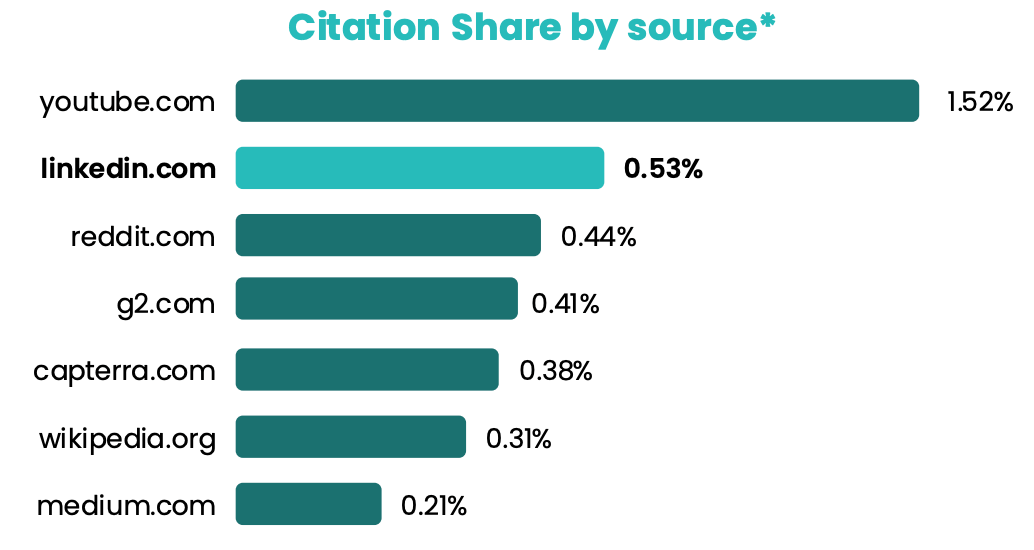
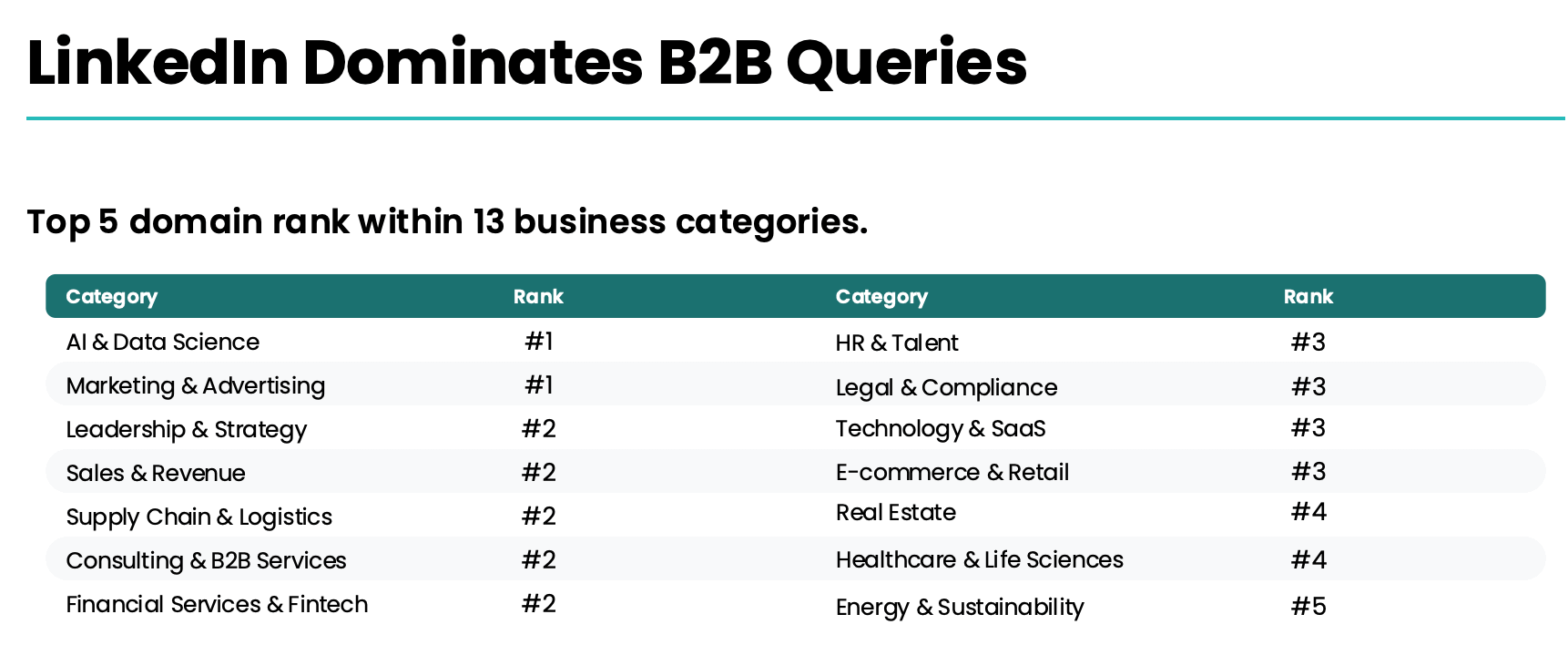
In just 4 weeks of tracking, LinkedIn's citation share grew by 26%, moving into the top five most cited sources in 14 B2B categories, including No. 1 in artificial intelligence and marketing.
75% of LinkedIn citations link to personal profiles rather than company pages, and 51% of citation creators have fewer than 10,000 followers. Job titles are more important than specificity; cited posts are called real tools, contain hard numbers, and are built from titles and bullet points, characteristics that 92% or more of the most cited articles have. List articles and side-by-side comparisons account for more than half of citation content. Pure opinions rarely do.
Recency is also important. 48% of cited content was published within the past three months, and only 12% was older than a year.
Think of LinkedIn as training data for the answers potential customers get when they ask ChatGPT to compare booking engines or recommend PMS. Founders posting two to three specific, numbers-driven updates per week can have a greater impact on discoverability than a company page. Reading + melting water.
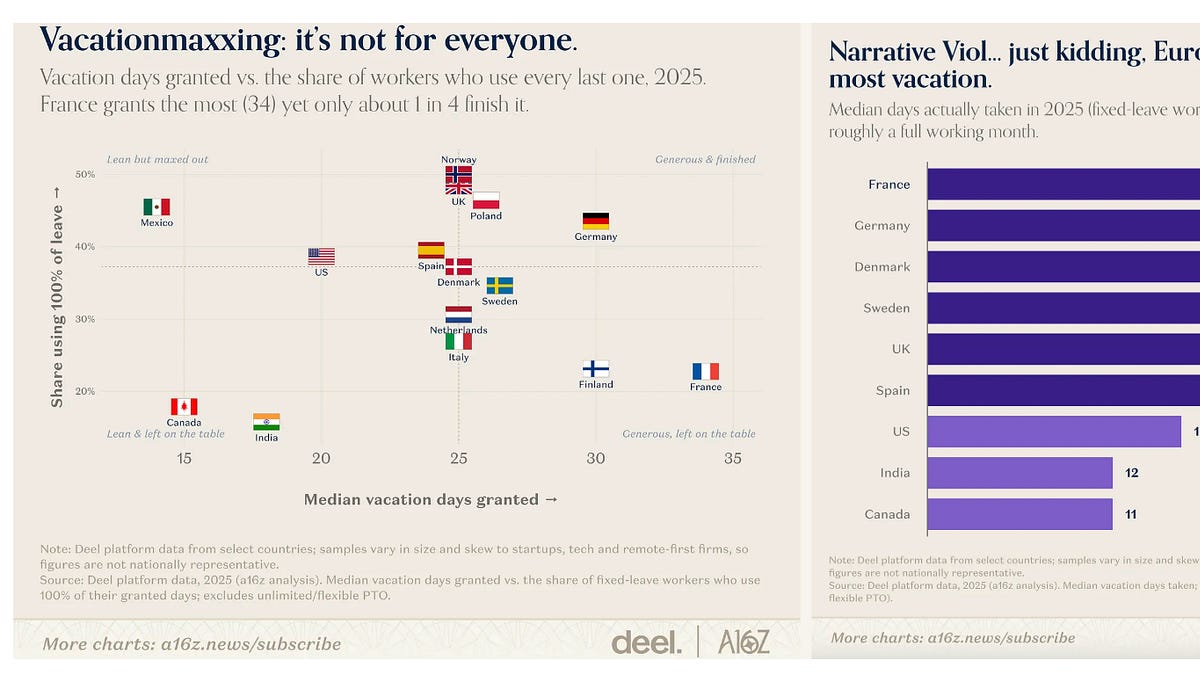
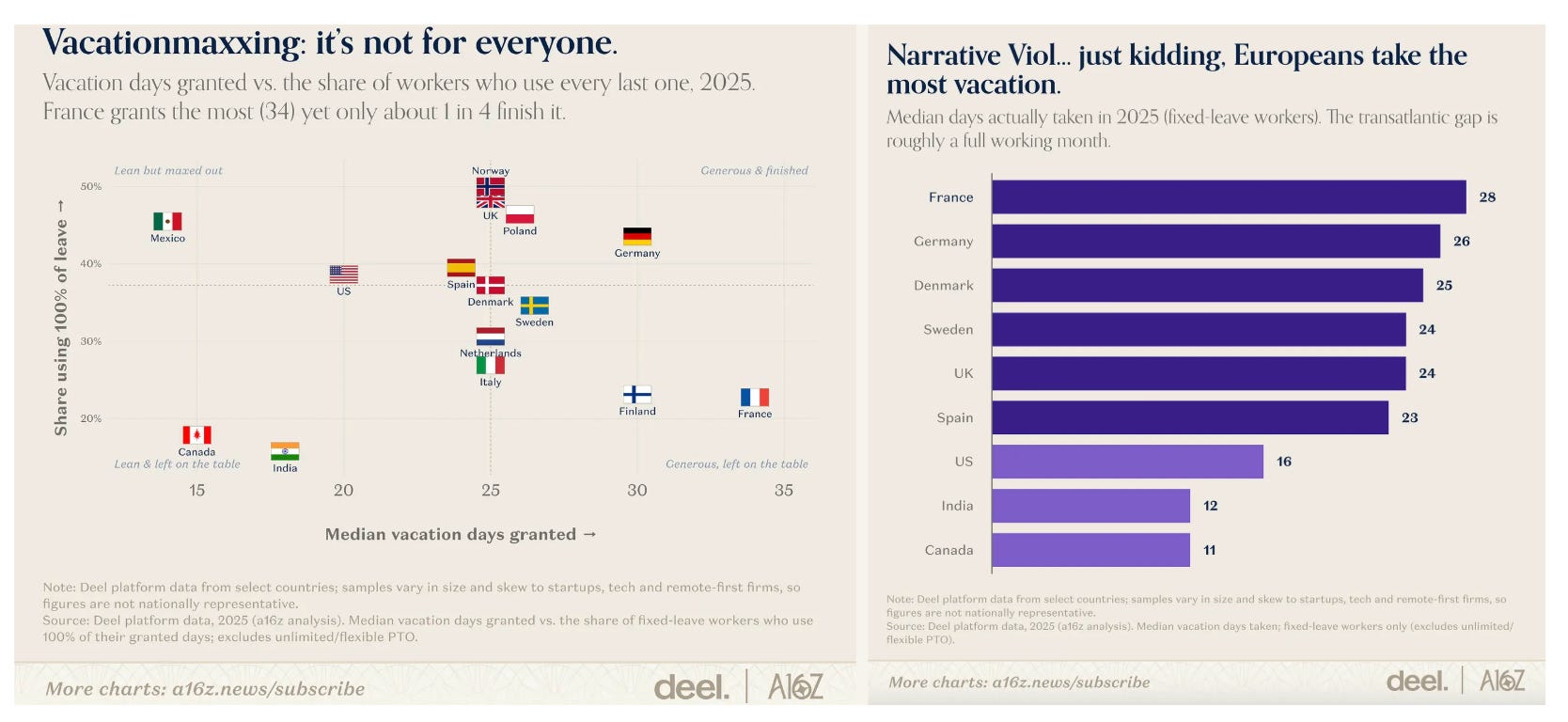
a16z extracted holiday data for more than a dozen countries from Deel.
France has the highest number of vacation days in the data set (34 days), but the average worker still has 28 vacation days. Mexico has about half as many vacation days as France, but has one of the highest usage rates. Vacation policies and actual time off are not as consistent as you might think.
By mid-August, about a third of Italian and French workers were out at the same time. There was little activity in the United States over the summer, and none in Mexico, Canada, the Philippines, or India.
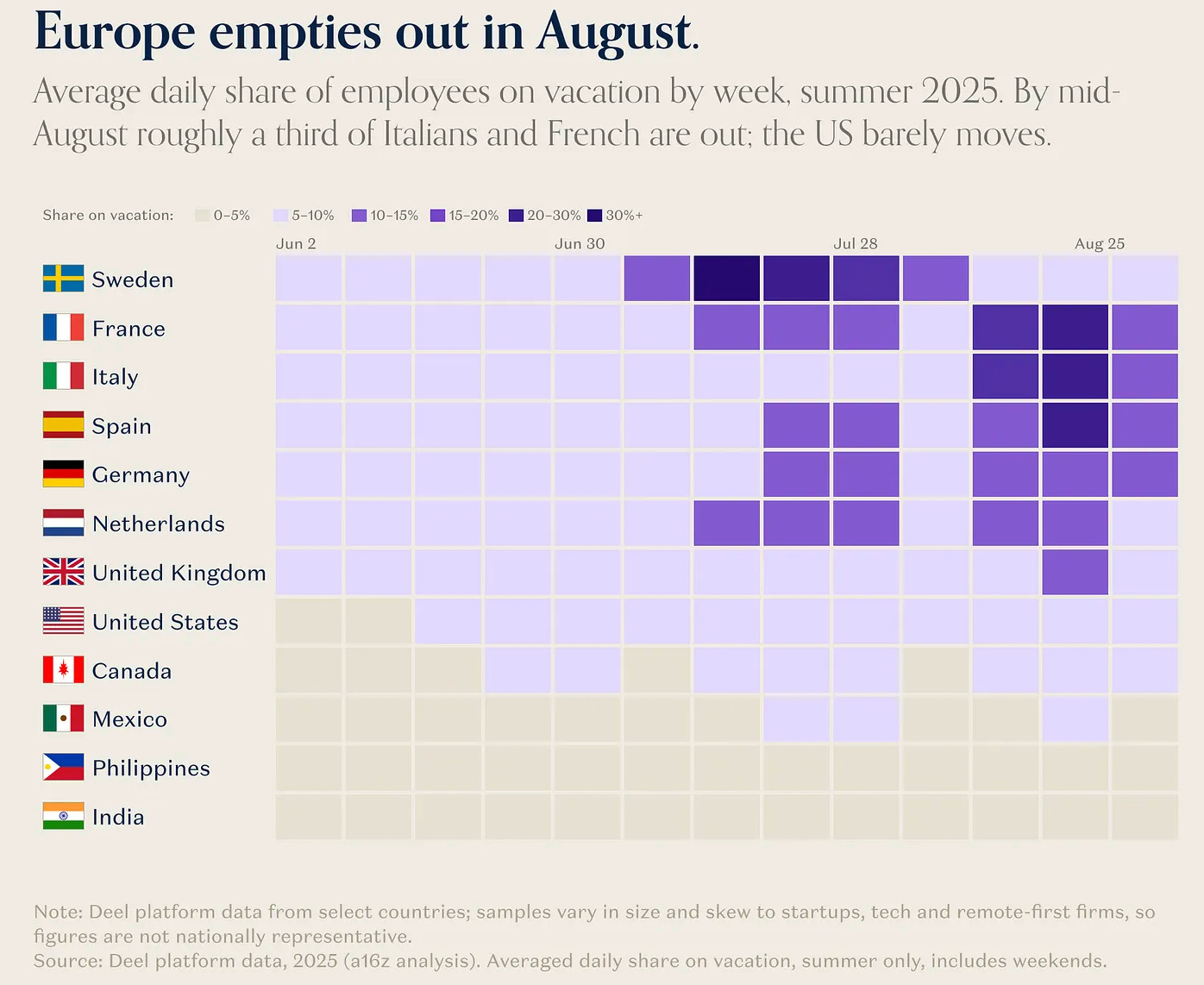
Go to a16z Check out other interesting holiday charts, including how holiday times vary by workday, how sick leave breaks down by country, and which birthdays people take off work on.
I saw a picture of a “compare and save” sign at a drug store where condoms cost as much as diapers. It takes a second to land and then there's a click, and that click is the whole appeal. Two unrelated things, sitting side by side, dare you to find the connection.
Ryanair is also in the same game, offering pizza and flights, both for $19.99. That's not to say either item is cheap. It takes advantage of the surprise of seeing two unrelated prices match. Just realized that the flight to Pisa costs the same as the pizza. as i Shown in previous newslettersAir Transat is offering a version with bets, a $3,563 World Cup ticket and a $429 flight to Mexico, “for the price of 90 minutes at the stadium, you can spend a week in the country you support.” Different mechanics, same instinct. Put two unrelated things together and let the reader do the work of connecting them.
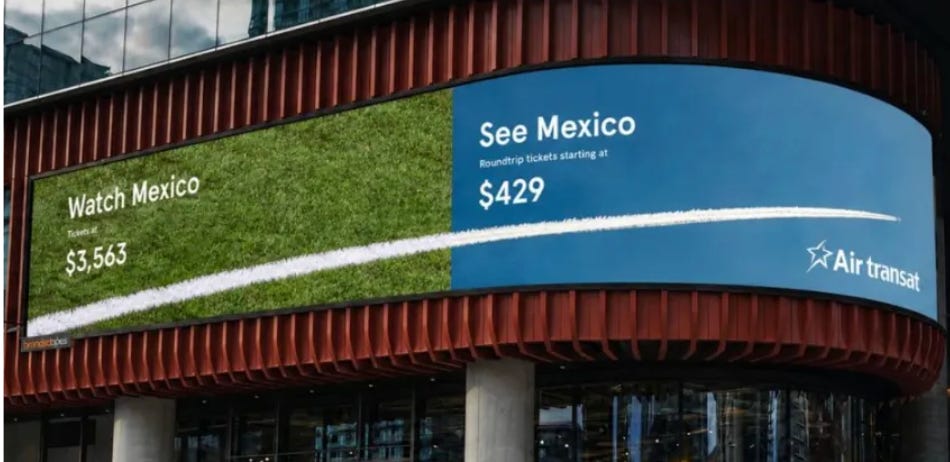
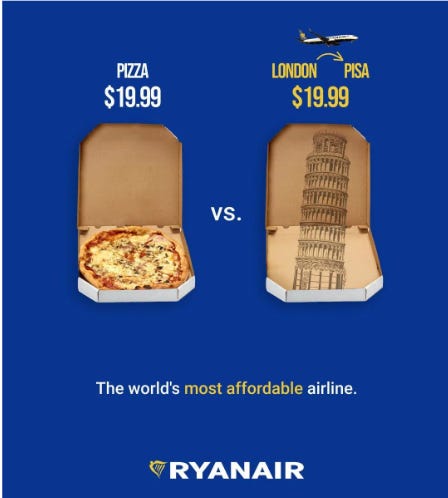
Most travel pricing skips this point entirely, by making one predictable comparison after another. Unrelated pairings are the rarer ones, and the ones that people stop and watch.
“I use Cursor externally. It's great. Why isn't our internal stuff good? When can we have an agent here?”
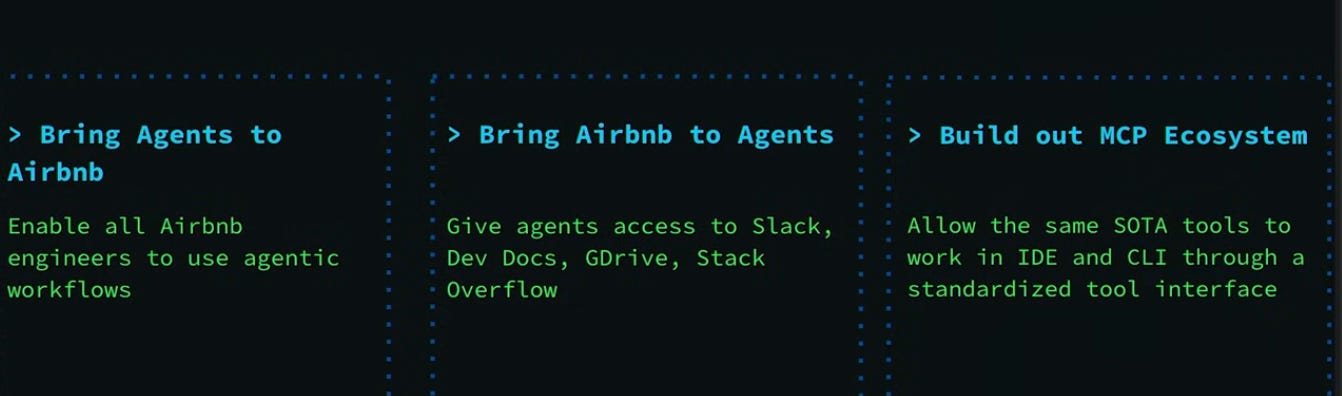
As described by developer platform engineers Szczepan Faber and Mike Nakhimovich, that's the gist of an email sent by Airbnb leadership on Friday night that kicked off their agency coding push. Speaking at the DPE Summit in October 2025, they said that at that time approximately 64% of Airbnb's code changes were written with artificial intelligence doing most of the typing work and engineers directing the work, a model they called agent coding. At the beginning of 2025, they expected to only reach 20-40% by then, so they exceeded their own forecasts.
Several things make this possible. A team of four built Airchat, a simple installer that places AI coding tools like Claude's co-pilot on every engineer's laptop and keeps it updated automatically. Behind it is a growing set of internal connectors (MCP servers) that enable AI to access Airbnb-specific knowledge. This includes cloud configurations, preferred coding modes, deployment practices, and other internal context. The goal is to avoid one-size-fits-all answers and give the AI the same context as an experienced Airbnb engineer.
Guardrails play a central role. Every AI-written code change still goes through a human review before being released. Engineers gradually gain more autonomous AI behavior based on experience and trust, rather than through global switching. Rather than building a custom all-in-one AI IDE, the team focused on packaging powerful existing tools and investing in connectors, strategies, and integration with current workflows. Watch + DPE Summit Presentations
2026 Update: As of Airbnb's first-quarter 2026 earnings report, leadership said nearly 60% of engineering code is now co-written with artificial intelligence. This is not directly comparable to the 64% number shared at the DPE Summit in October 2025, which refers to internal developer platform metrics rather than company-wide engineering metrics. The same agent infrastructure now powers a support bot that resolves approximately 40% of customer issues end-to-end, and is being expanded to internal tools and early AI-assisted search experiments. What started as a coding initiative has become the broader operating model for how Airbnb builds its software and operates parts of its business.
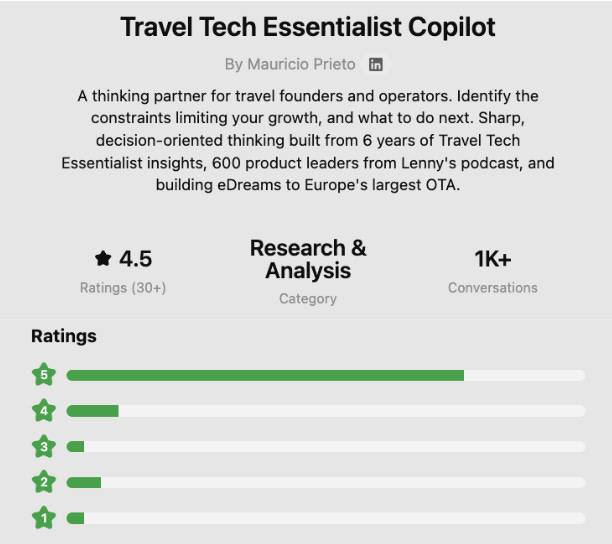
It answers ideas we've thought about before, but is more decisive and sharper than regular ChatGPT or Claude. Thanks for making this public. — Holly Clarke, Chief Marketing Officer, bypass
this Travel Technology Essentials Co-Pilot Currently has over 1,000 conversations and a rating of 4.5. Try solving a problem you're working on and let me know where I went wrong.
If you're a startup looking to raise a round of funding (from pre-seed to Series D), I can help (for free). Tourism Investor Network is a private platform where I recommend innovative travel startups to investors and innovators. If you are interested, please start from fill in this form.
If you find value in Travel Tech Essentialist, the best way to express it is by sharing it with others who appreciate it:
If you haven't subscribed yet, please join us here:
Thank you for trusting my inbox.
Mauricio Prieto