

Not all moats survive. This version is about what's done: a market where you've actually won the right to occupy, a network where it's increasingly difficult for each new user to leave, a distribution that agents can't commoditize overnight. and the hidden tax paid by the founders to build any of them.
A little question. Travel technology essentials send co-pilot Since I launched it a few weeks ago, there have been over 400 conversations. I don't know what they are talking about. ChatGPT doesn't give me this data.
Then I asked directly. If you try it, I'd love to know two things: what problem you were trying to solve and whether it actually helped. One sentence or ten sentences, whatever feels right. Just hit reply.
I built it for travel founders and operators. The only way I know if it works is if you tell me.
Pear VC Pepe Agger breaks down What early investors want to see. An important takeaway for travel founders is that bottom-up market scaling will beat top-down market scaling every time.
Travel founders are particularly guilty of the decline in “$1.5T in global travel bookings.” This signals to investors that you haven't thought carefully about your customers or how you connect with them. Bottom-up numbers, the number of customers you are likely to reach times the price they actually pay, tell investors you understand your business. The trillion dollar number tells them you read Statista.
His traction frame is also changing in stages. Pre-seed, you are validating the idea. Seed, you need a handful of people obsessed with your product. Founders often confuse “we have hotel partnerships” with a passion for the product. These are not the same thing.
I shared a Version on LinkedIn It resonated last week, so I'm expanding on it here with things I left out.
When you work at Google, McKinsey, or Booking.com, doors open, emails get answered, and people answer your phone calls. Most of the time, this is a sign. A borrowed coat. Entrepreneurs don’t have that. Every door you open, you open yourself. Every email that gets a reply is a bonus for you. No free rides, no borrowed credit. This is a hidden tax.
I co-founded eDreams in 1999, served as chief marketing officer and board member, and worked for 15 years through the company's IPO. We felt this from day one. In Barcelona, convincing local talent to join an unknown startup is harder than recruiting talent from Australia, Israel or the United States. Airlines and travel providers barely answer our calls. Every meeting we have is something we strive for.
Taxes don't go away when you build something real. It reappears when you step out of your environment. When I moved to the Bay Area in 2015, no one had heard of eDreams, a European company not registered in the Bay Area. Same person, same record, different country code.
So if you’re sitting in one of these institutions right now, here’s a quick question: reply to that founder’s email. Attend that meeting. Make an introduction. It costs you next to nothing. For them, it could change everything. You never know how quickly roles can change.
If you're a founder who pays taxes…it's true, not just you, and almost no one talks about it. But this is also temporary. You are building your own mantle, one relationship at a time. Ultimately, it feels better than a borrowed jacket.

Many AI companies are building tools to make agents, revenue managers, and operations teams more productive. This is the co-pilot model: AI in the hands of professionals, making them faster and sharper. Autopilot modes are different. You're not selling a tool, you're selling a job. Customers purchase results directly.
Sequoia Capital's Julien Bek believes that in the long run, the winning companies will be the ones on autopilot. Reading + Sequoia
Travel already has the conditions for autonomous driving to be implemented. Insurance distribution, revenue management, customer service at scale…much of the groundwork in these areas is rules-based and already handled by external providers.
Bek's key insight is to start where outsourcing already exists. If a task is already done externally, budget lines exist, and the buyer expects an outside supplier, it's much easier to change suppliers than employees. For every dollar spent on software, six dollars are spent on services. The autopilot will follow six o'clock.
Roadblocks in the journey may lie in TMC contracts, outsourced revenue management retention, distribution agreements with brokers, etc… Everyone has a budget line, the incumbent is doing repetitive work, and the buyer is already comfortable with an outside provider.
The long-term question for travel AI founders has shifted from “What tools can I build?” to “What tools can I build?” to “What jobs can I have?” That’s where the real opportunity lies.
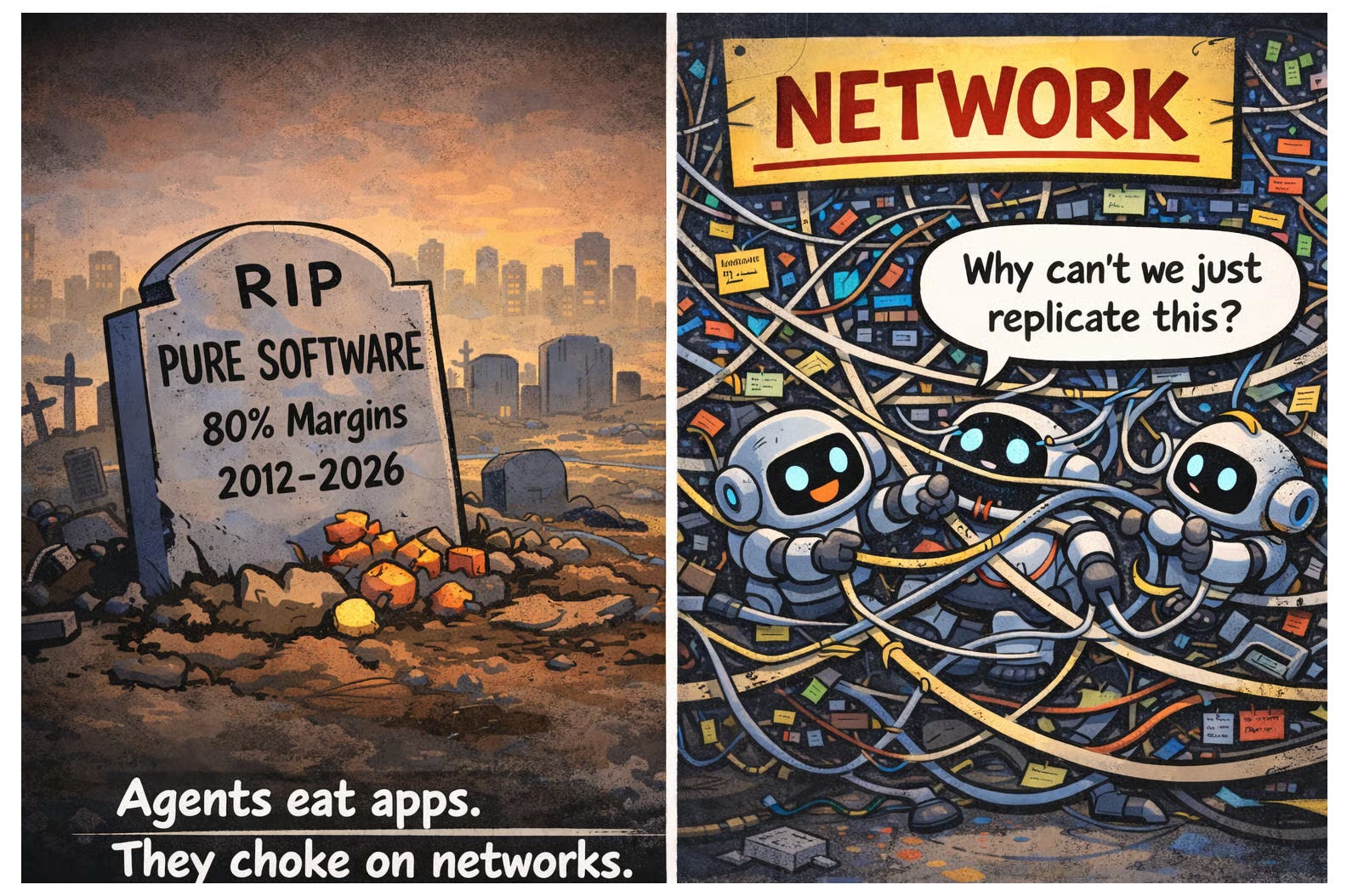
Yoni Rechtman of Slow Ventures brings up a distinction that's easy to overlook. polymerization Collecting options in one place. Useful, but doesn't trap anyone. The user can leave at any time and the agent can replicate it overnight. network effect is different. The more people who use the product, the better it becomes and the harder it is to get rid of. As Yoni said: “Aggregation creates value. Network effects capture it.” Reading + Joni Rechtmann
Agents can scan the web for flights, hotels and experiences in seconds. If your value is “we have everything in one place” then an agency can and will replicate that. What a proxy cannot replicate is a real network. A platform for hosts and guests to build reputations, or a marketplace for reviews to compound over time.
Many travel startups are working on a checklist. A curated set of providers, experiences, or options. It's a defensible business when search and discovery are difficult, but it's much weaker when search is free and instant.
Take solo travel startups, for example. flash packageFor example, it has tended towards the community layer: alumni groups, repeat travelers, a sense of belonging that lasts longer than travel. Every repeat customer leads to a better product for the next traveler. That's a network. A startup that plans great trips for strangers, but most people only take one trip and move on, with compelling branding and curation. But the value is in logistics and taste, not complex communities. One is agent verified and the other is not.
Before making your next product decision, ask if adding one more user will make the product better for everyone else. If the answer is no, then you are building an aggregate. It's not a death sentence, but you should know what game you're playing.
Anthropic published a detailed study on how artificial intelligence agents are used in practice. Software engineering accounts for nearly 50% of all agency activity. Tourism ranks at the bottom with 0.8%. Reading + Anthropology
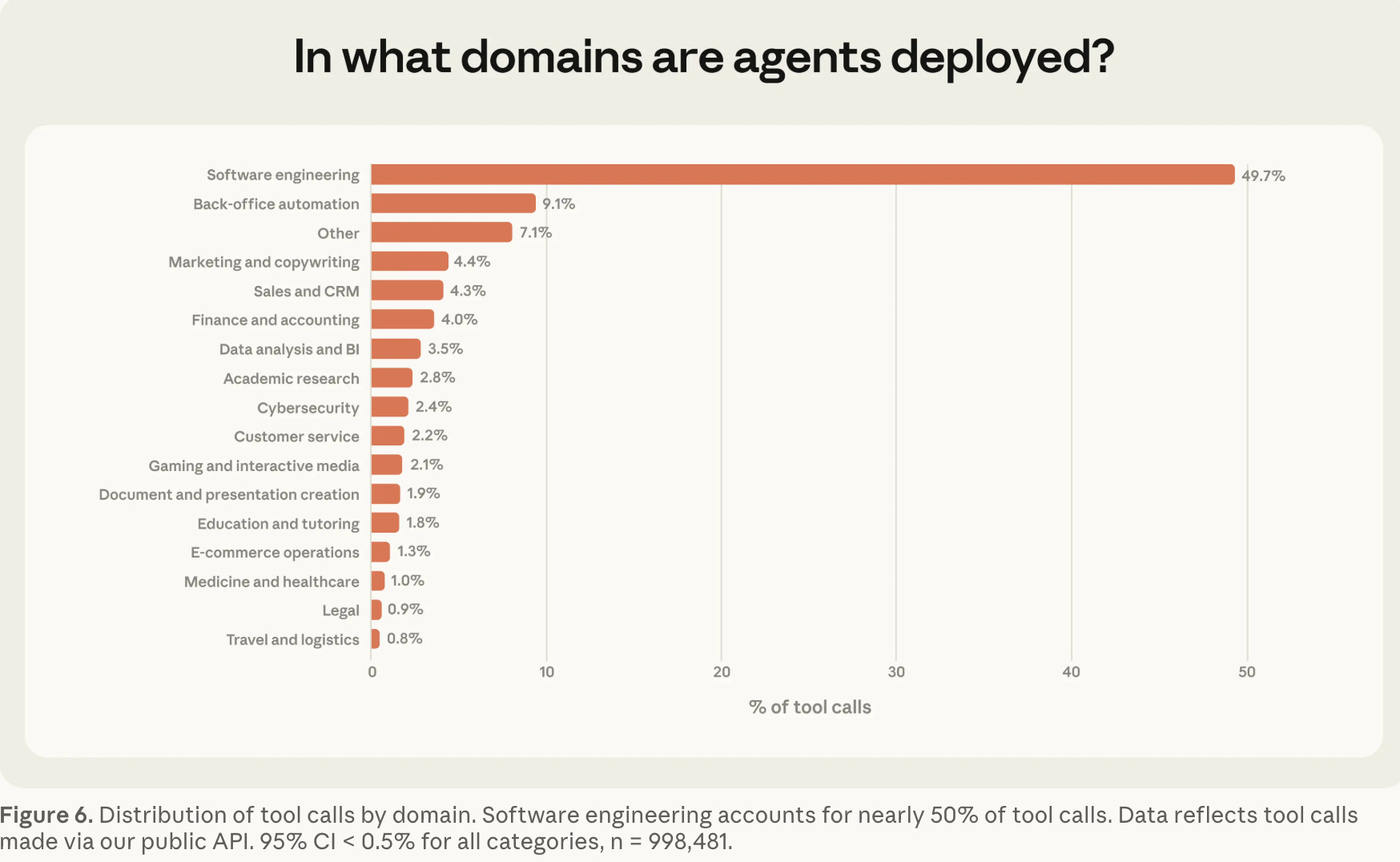
This gap has less to do with the maturity of the tour operator and more to do with the risk faced if things go wrong. Today, most agent activity occurs in domains where errors are thought to be detectable and reversible, although this assumption is being tested (Amazon recently Artificial intelligence-related issues caused a nearly six-hour site outage). While traveling, the consequences are even more severe. Bad bookings propagate into real-world logistics…wrong hotels, missed transfers, ruined trips. The adoption curve is likely to follow a risk gradient: research and price monitoring first, regulatory bookings second, and then fully autonomous trading once accountability structures are in place to support them.
The 0.8% figure itself is questionable. Travel is not as missing from the proxy data as it may seem. Software engineering includes PMS, RMS, booking engine systems, backend automation, CRM, running the industry and marketing tools used daily by tour operators. BCG vaccine report 37% of travelers already use artificial intelligence embedded in online travel sites to plan and book travel, and AI-driven pricing has increased revenue per room by more than 15% for some hotels. AI activity in the travel industry is real. It's just being counted in someone else's column.
One of the most important questions for founders is how to ensure agents understand their product/service and choose it? All the old tricks don't work anymore.
Brian Flynn thinks AI agents don't browse the web; they ask. They have no brand loyalty, are not driven by impulse, and are not influenced by the attention economy. They just focus on: Can you solve my problem? How fast, how much, how reliable? What matters is your API.
In a scan of 44 proxy services, only 2 had fully functional endpoints. 53% of direct service calls are successful. Flynn concluded that in the agency business, reliability is the entire product. Read + Brian Flynn
For travel, this redefines the distribution problem. The industry has spent decades mastering distribution to people: search advertising, metasearch rankings, OTA placement, landing page optimization. There was no response from the machine buyer. Hotels, airlines or activity providers who want AI agents to be visible need machine-readable functionality, protocol-based pricing and provable reliability scores.
Hotels have spent years and huge sums of money trying to crack personalization: loyalty programs, CRM platforms, tracking pixels, third-party data partnerships. Most people still can't do this effectively. The data flywheel that powers Amazon doesn't have the same physics in the hospitality industry. A loyal guest checks in twice a year, but that's not enough to send a signal.
exist this articleGautam Lulla makes an astute observation. Generative hotel websites (websites that dynamically respond to each visitor's request rather than serving static pages waiting to be browsed) can solve the entire problem. The site aggregates content in real time around guests' specific questions. No behavioral profile is required, and no previous data is required. Guest intent replaces years of accumulated data.
The same content architecture that powers it also makes hotels visible and accurately represented to AI agents (the next distribution facet).
BCG narrowed down the same problem. Brand equity in the hospitality industry is shifting from visibility to algorithmic relevance. In an AI-driven discovery environment, hotels that the AI agent cannot read and confidently recommend simply won’t show up in the results. It’s not a matter of ranking lower, being penalized, or paying too much commission. The problem is absence.
Mechanisms are important. AI engines favor comprehensive, high-trust, multi-source content attributes. Guest reviews, syndication across authoritative platforms, consistent digital presence: these become core business levers. Sparse or inconsistent footprints are filtered out.
The industry has spent two decades figuring out their complicated relationship with OTAs. It's the same fight, with higher stakes and less time to prepare. Read + BCG AI Priority Hotels
The travel industry devotes more of its advertising budget to search than many other consumer categories.
The harder question is what happens when an AI agent makes recommendations that ad spend doesn’t directly impact.
Accordingly BCG vaccine reportOnly 10% of travel executives outside of CMO roles have marketing experience, compared with 40% in other consumer industries. BCG flagged the statistics without drawing conclusions, but it's hard not to. When the people approving the budget lack marketing instincts, long-term brand building loses out to short-term performance marketing every time.
→ Explore All 2194 vacancies Currently on the Tourism Technology Essentials Working Committee.
📩 For monthly updates on the latest roles, please subscribe Travel Technology Work Newsletter
If you're a startup looking to raise a round of funding (from pre-seed to Series D), I can help (for free). Tourism Investor Network is a private platform where I recommend innovative travel startups to investors and innovators. If you are interested, please start from fill in this form.
If you like Travel Tech Essentialist, please consider sharing it with your friends or colleagues. If you haven't subscribed yet, please join us here:
As always, thank you for trusting my inbox.
Mauricio Prieto