
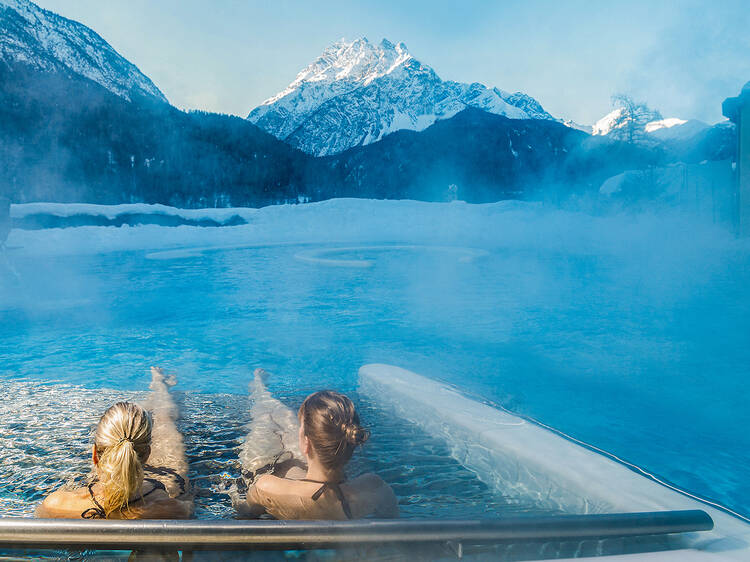
The mineral-rich waters draw visitors back to nature, and for good reason.
The first thing you'll notice is a lovely, ethereal feeling of weightlessness. As the salty, warm water envelopes you, your muscles begin to relax and soften. Often the surrounding scenery is wild and verdant, or maybe volcanic rock, or a beach horizon. No matter the setting, it's all natural and beautiful, and you'll feel instantly relaxed as you soak without restraint.
In an age defined by wearable trackers and biohackers, happiness feels cold and clinical to many people, and this impersonal approach is becoming exhausting. As a result, travelers are seeking wellness experiences that are less digital and more organic. Warm water rising from the Earth seems particularly attractive right now.
Sliding into a naturally heated mineral pool, whether in Iceland's volcanic lagoon or the salt-dense Dead Sea, provides a full-body stress-busting effect. The buoyancy feels great on the joints. Heat promotes blood circulation. And scenery, perhaps the greatest happiness factor, is often dramatic and unaffected, playing a role in resetting the nervous system.
This is an ancient practice. Civilizations from Egypt and Greece to Rome and Japan have built rituals around bathing in minerals and seawater. The thermal springs of Rome were social centers and wellness centres. In Japan, the history of bathing in geothermal hot springs dates back centuries. Across cultures, soaking in mineral waters is believed to relieve muscle tension, calm the body and support overall vitality.
Modern science supports these claims, showing that hot baths have a positive impact on the body on multiple levels. A large meta-analysis reviewing thalassotherapy (seawater-based therapies) found that it has clear benefits for inflammatory diseases such as psoriasis and rheumatic diseases such as fibromyalgia. Research also shows improved muscle recovery after soaking in mineral-rich water. Other research suggests that balneotherapy (the medical term for mineral baths) may reduce levels of cortisol, the body's main stress hormone. Lower cortisol is associated with improved mood and better sleep.
Then there’s what it does to your skin. A recent review of thermal water therapy found that mineral-rich baths can support microcirculation, calm inflammation and assist the skin's natural repair process. Soaking in natural spring water also rehydrates and strengthens that all-important skin barrier. After a luxurious heat soak, skin will emerge with a clearer, more hydrated complexion.
Much of the therapeutic effect may come from the mineral content. Thermal water is heated underground through geothermal activity. As they move through layers of rock and soil, they absorb minerals such as magnesium, calcium, selenium, silica and bicarbonate. What differentiates one spring from another is partly geology.
In Iceland, the water of the famous and stunning Blue Lagoon originates deep in the volcanic landscape, where seawater and freshwater meet and rise, rich in silica (which gives it its stunning vibrant blue color) and microalgae. The Dead Sea's extreme salinity is the result of thousands of years of intense evaporation, concentrating minerals to levels rarely seen elsewhere. In France, springs in places like Vichy and Avène are formed by rainwater filtering through mineral-rich rock formations, absorbing trace elements along the way. Each site has a unique mineral signature, and it seems that the more times you soak, the greater the benefits.
This may explain why geothermal destinations are becoming important again. In addition to measurable effects, they provide literal and figurative immersion. Many of the world's most famous hot springs are set among stunning volcanic plains, impressive mountains and calm coastal horizons. The sensory experience of being in nature, the warmth of the water, and the smell of minerals in the air all enhance physiological responses. Wellness travel has transformed from a fast-paced itinerary to a slow, time-honored traditional ritual. In this transition, a hot bath makes sense.